


Enhanced TDS
Identification & Functionality
- Chemical Family
- Agrochemical Functions
- Cleaning Ingredients Functions
- Technologies
- Product Families
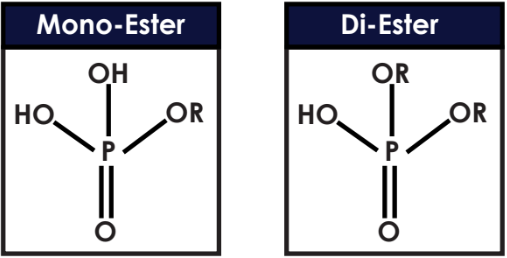
- Chemical Structure of Phosphate Esters
Features & Benefits
- Labeling Claims
- Agrochemicals Features
- HII Features
- General Properties of Phosphate Esters
- Alkali Stability and Solubility
- Coupling and Emulsification
- Detergency and Rinse-ability
- Increased Hard Water Tolerance
- Corrosion Inhibition
- Lubricity
- Wetting
- Thermal Stability
- Background on Phosphate Esters
- Phosphate Esters are anionic surface active agents produced by reacting polyphosphoric acid or phosphorous pentoxide with molecules containing hydroxyl groups - commonly ethoxylated moieties or alcohols. Reactions using phosphorous pentoxide result in a mix of mono and di-esters, while products made with polyphosphoric acid are high in mono-ester yield.
- Which type to use depends upon the properties needed in formulation. Mixed esters products are generally better for emulsification; whereas, mono- ester rich exhibit better hydrotroping properties.
Applications & Uses
- Markets
- Applications
- Home Care Applications
- I&I Cleaning Applications
Properties
- Physical Form
- Appearance
- Pale yellow liquid (at 20°C)
- Soluble in
- Water, Ethanol, Xylene, Perchloroethylene
- Insoluble in
- Mineral oil, Kerosene
- Typical Properties
Value Units Test Method / Conditions Caustic Solubility (in 18% NaOH at 25°C) 16.5 - - Activity min. 99.0 % Acid Values 287 - - Acid Values 147 - - Color max. 3 Gardner, ASTM D1544 Typical Acid Values (at pH 5.5) 147 mg KOH/g - Flash Point min. 250 °F Pensky Martens Closed-Cup Moisture Content max. 1.0 % - pH (at 1% aqueous Solution) 1.5 - 2.5 - - Pour Point max. 40 °F - Specific Gravity (at 68°F) 1.13 - - Weight (at 68°C) 9.4 lbs/gal - Typical Acid Values (at pH 9.5) 280 mg KOH/g -
Regulatory & Compliance
- Certifications & Compliance
- Chemical Inventories
- Regulatory Information
T-Mulz T9PE is exempt from a tolerance under 40 CFR 180.920 as inerts in pesticide formulations.
Packaging & Availability
- Packaging Type
- Supplied by