


Enhanced TDS
Identification & Functionality
- Chemical Family
- Chemical Name
- Molecular formula
- C₄H₁₃N₃
- Technologies
- Product Families
- Chemical Structure
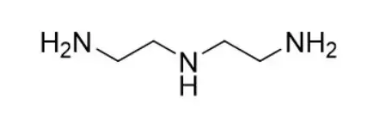
Applications & Uses
- Markets
- Applications
- Applicable Processes
- Base Chemicals End Uses
Properties
- Physical Form
- Soluble In
- Soluble in
- Water, Alcohol, Hydrocarbons
- SDS Physical and Chemical Properties
Value Units Test Method / Conditions Freezing Point (at 1,013 hPa) (-)39 to (-)38 °C - Vapor Pressure (at 20°C) 0.2 hPa - Density (at 20°C) 0.957 g/cm³ - Relative Density (at 20°C) 0.959 - - Lower Explosive limits 1 vol% - Upper Explosive Limits 10 vol% - pH (at 20°C) 12 - - Boiling Point (at 1,013 hPa) 207 °C - Relative Vapor Density 3.6 - - Autoignition Temperature (at 1,013 hPa) 358 °C - Dynamic Viscosity (at 20°C) 5.05 mPa s - Flash Point (at 1,013 hPa) 96.7 °C Pensky Martens Closed Cup Odor Ammoniacal - - Appearance Clear liquid - - Color Colorless - - Log Pow Partition Coefficient (at 20°C) -1.58 - - Explosive Limits Not explosive - - Soluble in Water - - Soluble in Alcohols, Hydrocarbons - - Oxidising Properties The substance or mixture is not classified as oxidizing - - - Characteristics
Value Units Test Method / Conditions Boiling Range (at 1013 hPa) 207 °C - Freezing Point (at 1013 hPa) -39 °C - - Specifications
Value Units Test Method / Conditions Assay min. 98.5 wt% MOA 552 Molecular Weight 103.2 - - Water Content max. 0.5 wt% MOA 305